The Shinobi Arsenal: Traditional Ninjutsu Techniques and Weapons
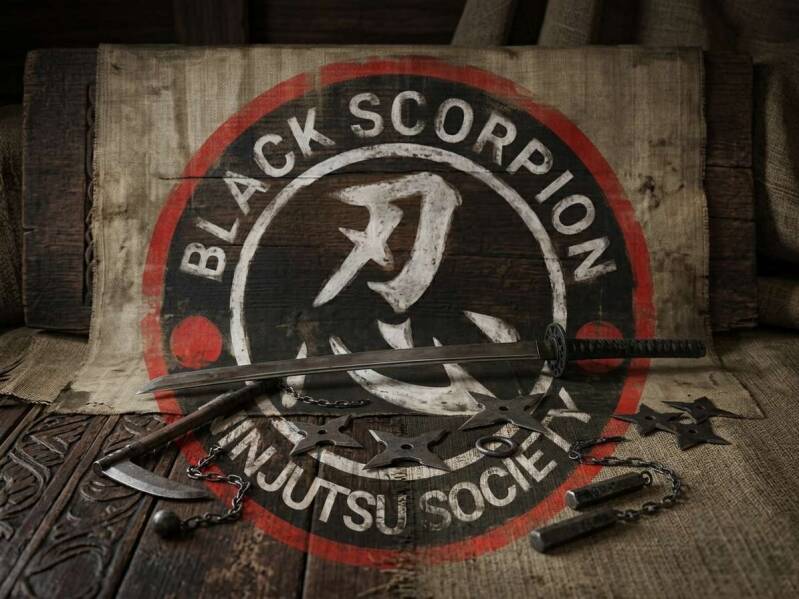
At the Black Scorpion Ninjutsu Society, we honor the profound legacy of the ancient shadow arts while exploring their evolution and application in the modern world. True Ninjutsu is not a series of magical tricks; it is a comprehensive system of survivalism, combat strategy, tactical utility, and mental endurance (Nin).
Whether you are an independent instructor looking to expand your knowledge, a combat sports practitioner exploring historical roots, or a global member wearing our society patch, understanding the authentic tools and techniques of the Shinobi is vital to your martial arts journey.
Part I: Fundamental Ninjutsu Techniques (Asa-giri)
In historical application, foundational techniques focused heavily on espionage, spatial awareness, and environment manipulation to bypass threats or escape superior numbers.
Body Replacement Technique (Kawarimi no Jutsu)
An advanced misdirection tactic. Rather than a literal magical transformation, this technique relies on blinding speed and situational awareness to quickly substitute one's positioning with a nearby object (such as a log or structure), causing an attacker to strike empty space while the operative repositions or escapes.
The Modern Bridge: In a real-world self-defense or active threat scenario, Kawarimi translates to dynamic environmental shielding and breaking line of sight. Instead of dropping a wooden log, you utilize immediate physical geometry—such as stepping behind a concrete pillar, slamming a door between yourself and an attacker, or shoving a heavy trash can into their path while executing an immediate tactical retreat.
Cloaking & Concealment (Kakuremi no Jutsu)
The art of blending seamlessly into any immediate environment. Operatives utilized specialized cloths, drapes, and the natural contours of shadows or terrain to obscure their outline from guards and sentries.
The Modern Bridge: Modern concealment relies heavily on understanding "visual noise" and the concept of the Gray Man. To disappear in a modern city, you do not wear dark robes; you wear standard, non-descript clothing that perfectly matches the local demographic. You "hide" in plain sight by mimicking the baseline behavior of the crowd, avoiding eye contact, and staying out of the direct glare of security cameras or streetlights.
Rope Escape Technique (Nawanuke no Jutsu)
A crucial survival art involving joint manipulation, skeletal flexibility, and the deployment of small, concealed tools to quickly slip free from ropes, binds, and restraints.
Water Navigation (Mizugumo no Jutsu)
Tactical movement across bodies of water, rivers, and castle moats. This involved specialized stealth swimming mechanics alongside utility gear like floating wooden water shoes to cross obstacles without giving away one's position.
Leaping & Roof Mechanics (Tobijutsu / Noborijutsu)
Methods for scaling high stone walls, clearing structures, and navigating rooftops silently. A primary focus is placed on structural alignment and proper biomechanics to land completely silently from great heights without causing self-injury.
The Art of Disguise (Henzōjutsu)
Infiltration by social engineering. Practitioners blended directly into enemy territory by perfectly adopting the mannerisms, language, and apparel of common civilian professions—such as wandering monks, merchants, performers, or farmers.
The Modern Bridge: Today, Henzōjutsu is the ultimate form of social engineering and situational pretexting. By carrying a clipboard, wearing a high-visibility safety vest, or simply dressing in the uniform of a standard delivery driver or utility worker, an operative can bypass psychological boundaries and blend effortlessly into restricted or sensitive environments without drawing a second glance.
Stealth Walking (Shinobi-aruki)
Specialized footwork designed to minimize sound and vibration. By shifting body weight deliberately and walking on the outer edges of the feet, practitioners could navigate creaking wooden floors or crisp wilderness leaves in total silence.
Part II: The Traditional Weapons of the Shinobi
True ninja weaponry was born out of brutal utility. Many of these implements were adapted directly from ordinary farming and agricultural tools, enabling an operative to travel openly across provinces without arousing the suspicion of feudal authorities.
The Shinobigatana (The Ninja Sword)
Unlike the elite, highly polished katana of the samurai class, the Shinobigatana was a tool of rugged, clandestine functionality.
The Design: It featured a shorter, straighter blade optimized for lightning-fast draws and thrusts inside tight, enclosed castle corridors. The blades were typically chemically blackened or lacquered to prevent moonlight from reflecting off the steel.
The Utility Scabbard (Saya): The scabbard was crafted longer than the blade itself, leaving a hollow tip used to stash secret documents or blinding powders (metsubushi). The heavy, square handguard (tsuba) was engineered as a step to assist in scaling walls, and the bottom cap of the scabbard could be removed to serve as a functional underwater breathing tube.
The Modern Bridge: While carrying a straight-bladed sword is impractical today, the core principles of the Shinobigatana—compact size, fast draw speed, low reflectivity, and multi-functional gear—map perfectly onto modern short-barreled home defense platforms or modern tactical machetes. The philosophy of a hidden utility compartment in the scabbard lives on in modular tactical gear and hidden storage compartments within modern everyday carry (EDC) apparel.
The Tantō (The Piercing Dagger)
The tantō is a compact Japanese dagger under twelve inches in length. Favored heavily by close-range operatives and female practitioners (*kunoichi*) for its supreme concealability, it could be hidden effortlessly inside a sash (*obi*) or wide kimono sleeves. Often forged with an extra-thick spine (*Yoroi-dōshi*), it was specifically engineered to pierce the gaps and unprotected joints of traditional armor.
The Modern Bridge: The core principles taught in Tanto-Jutsu directly apply to modern EDC (Everyday Carry) tactical knives, reinforcing the BSNS philosophy: the tool may evolve, but the physical mechanics remain absolute.
The Ninja Bow & Arrow (Shinobi-yumi & Ya)
Long-range precision required compact solutions. The Shikomiyumi was a folding or collapsible bow designed to be broken down and concealed inside civilian travel packs. It was deployed with specialized arrows to ignite fires, create distractions with whistle-tips, or silently neutralize sentries with potent botanical poisons.
Throwing Stars & Blades (Shuriken)
Divided into Hira-shuriken (flat multi-pointed stars) and *Bō-shuriken* (straight iron spikes). In historical reality, these were rarely primary lethal weapons. Instead, they were treated as defensive tools coated in natural toxins, thrown to delay pursuers, or used as a sharp distraction to create an escape window.
Modern Bridge: While historically thrown to distract or wound, the underlying mechanics of hand-eye coordination and pocket-sized objects translate today into utilizing tactical fistload tools, pocket sticks (like a kubotan), or throwing whatever ambient object is available to create an opening to flee.
The Sickle and Chain (Kusarigama)
An ingenious adaptation of a standard agricultural harvesting sickle attached to a heavy iron weight via a long chain. The chain was whirled to entangle an opponent's sword, spear, or limbs from a distance, allowing the user to safely close the gap and deliver a decisive strike with the sickle blade.
The Modern Bridge: The physics of the Kusarigama—using a flexible, weighted line to entangle and control a weapon before delivering a strike—applies directly to improvised flexible weapons. In an emergency, a sturdy leather belt, a laptop charger cord, or a heavy padlock zipped inside a jacket sleeve can be whirled to keep an edged-weapon attacker at bay, control their limbs, or create a safe distance to escape.
Concealed Claws (Shukō / Tekkagi)
Metal bands fitted with sharp iron claws worn securely over the hands or wrists. This tool provided a vicious advantage in close-quarters slashing or weapon parrying, while doubling as highly efficient climbing spikes for scaling trees and castle masonry.
Weaponized Cane or Staff (Shikomizue)
The ultimate weapon of plain-sight deception. To all onlookers, the shikomizue appeared to be an ordinary, innocent wooden walking staff used by a traveler or monk. Hidden inside the hollow wood, however, was a spring-loaded or friction-locked blade, chain, or spearhead.
Bōjutsu, Hanbō, & Tambo (Staff & Stick Weapons)
Modern Bridge: Mastery of various stick lengths easily transitions to everyday objects found in the modern environment. A long staff translates to a broom or umbrella, while shorter sticks map onto a tactical flashlight, rolled-up magazine, or a sturdy cane.
The Modern Bridge: Plain-sight deception remains one of our strongest modern assets. The Shikomizue philosophy is perfectly represented today by custom tactical umbrellas engineered with high-strength fiberglass shafts, or heavy-duty composite walking canes that look entirely medical but function as devastating, impact-resistant self-defense tools that can easily pass through airport security checkpoints.
The Rope and Anchor (Kaginawa)
A traditional multi-purpose tool consisting of a multi-pronged iron hook attached to several yards of rugged hemp rope. Used primarily as a climbing aid to scale compound walls, hook onto high branches, or secure horses, it doubled as a mid-range binding weapon in close combat.
The Modern Bridge: The Kaginawa is the direct ancestor of modern tactical extraction and utility lines. Today, this translates to keeping high-tensile 550 paracord, rapid-deployment carabiners, and compact mechanical ascenders in your tactical pack or vehicle. It teaches the modern survivalist the critical importance of knot-tying, structural anchor identification, and vertical terrain management.
Blinding Powder & Disruptives (Metsubushi & Makibishi)
Psychological warfare and escape tactics always took priority over standing to fight a formal duel.
Metsubushi: Hollowed eggshells or small paper packets packed with ground pepper, ash, or iron filings were thrown directly into an enemy's eyes to instantly blind them.
Makibishi: Sharp, dried water chestnuts (tennen-bishi) or forged iron caltrops scattered across the ground during a retreat to instantly pierce the footwear of any pursuing guards.
The Modern Bridge: This traditional foundation underpins our training in modern situational awareness, including the strategic deployment of modern tactical flashlights and defensive sprays.
Shinobi Rokugu (The 6 Historical Tools of the Ninja)
Modern Bridge: As highlighted in modern adaptation doctrines, the historical loadout translates seamlessly into an everyday carry (EDC) kit. The Amigasa (straw hat) becomes a baseball cap; the Kaginawa (grappling hook) becomes a tactical paracord belt; the Sekihitsu (slate pencil) becomes a tactical pen; Kusuri (field medicine) becomes a modern IFAK (Individual First Aid Kit); the Sanjaku Tenugui (cloth) maps onto a modern bandana/shemagh; and the Uchitake (fire starter) bridges into a standard lighter or ferro rod.
Part III: The Strategic Philosophy of the Craft
Every weapon in the Black Scorpion curriculum is studied through a dual lens: Omote (the public, innocent explanation) and **Ura** (the hidden, tactical application). By training with intention, maintaining silent gear, and understanding how to turn ordinary, everyday objects into life-saving tools, a practitioner transitions from a simple combatant to a true survivalist.
Ready to Advance Your Journey?
The Black Scorpion Ninjutsu Society is a global community defined by shared knowledge, martial excellence, and real-world resilience. Whether you want to train one-on-one in Nashville, Tennessee, attend our intensive regional training camps, or apply to become a certified Regional Representative in your area, your legacy begins here.
Ninja Lock Picking (Tonyu-jutsu).
In traditional Ninjutsu, bypassing security wasn't about brute force; it was about absolute silence, speed, and using whatever was on hand. Ancient practitioners modified everyday items like hairpins (kanzashi), specialized iron picks (shikoro), or even the tips of their gear to slip past traditional Japanese wooden latches and lock mechanisms.
It wasn't just a physical skill—it was a masterclass in patience and situational awareness.
Taijutsu (Body Art).
Taijutsu (Body Art): The science of natural, unified movement. Instead of relying on raw muscular strength, Taijutsu teaches you to weaponize your entire body mass through proper alignment, fluid mechanics, and structural leverage. It transforms your natural geometry into a tool of effortless power.
Modern Bridge: Instead of relying on rigid, archaic stances, modern Taijutsu bridges into real-world posture, spatial awareness, and leveraging an opponent's momentum. It translates into managing distance in a street altercation and maintaining balance when grabbed or pushed unexpectedly.
Tai Sabaki (Body Movement).
Tai Sabaki (Body Management): The art of tactical evasion. Rather than clashing head-on with aggression, Tai Sabaki is the precise footwork and angling required to step off the line of attack. By mastering spatial blind spots, you ensure you are never where the enemy strikes, but always exactly where they are vulnerable.
Modern Ninjutsu Self Defense Techniques provides an excellent breakdowns on adapting traditional historical shinobi training and tools directly into functional modern street defense assets.